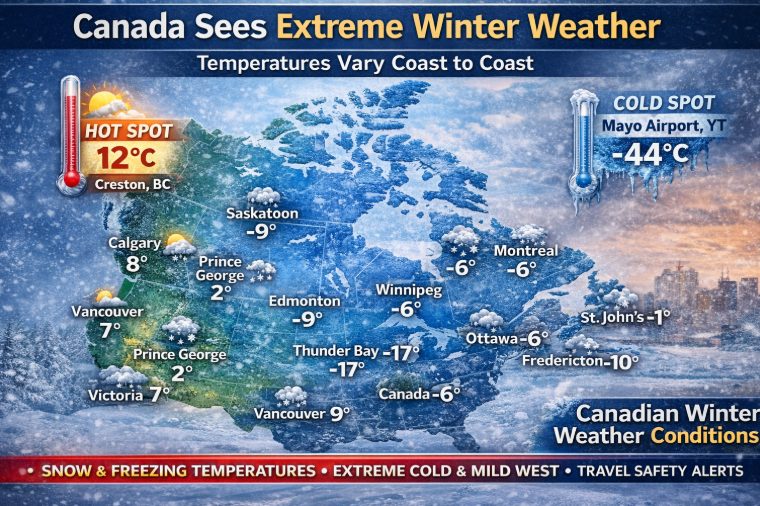
Extreme winter weather across Canada shows dramatic temperature contrasts, from mild conditions in British Columbia to severe cold in the Yukon and central regions.
Canada Sees Extreme Winter Weather as Temperatures Vary Coast to Coast
Canadian winter weather conditions continue to show dramatic contrasts, with parts of the country experiencing extreme cold while others enjoy relatively mild temperatures. This hour’s national weather snapshot highlights the vast range of climates affecting Canadians from coast to coast.
The warmest location in the country is Creston, British Columbia, where temperatures have climbed to 12.4°C, reflecting milder Pacific air influencing western regions. In stark contrast, the coldest temperature has been recorded at Mayo Airport in Yukon, where the mercury has plunged to an extreme −44.1°C, underscoring the severity of Arctic air dominating northern Canada.
Across eastern and central Canada, winter conditions remain firmly in place. Light snow and drifting snow are impacting cities such as Charlottetown, Montréal, Québec City, Iqaluit, St. John’s, Yellowknife, and Whitehorse, reducing visibility and creating hazardous travel conditions. Thunder Bay is among the coldest major centres at −17°C, while Winnipeg is reporting mist and temperatures near −9°C.
In Ontario and Quebec, major urban areas including Toronto and Ottawa remain cloudy with temperatures hovering around −6°C to −7°C. Meanwhile, Halifax and Fredericton are experiencing clearer skies but continued cold, typical of mid-winter conditions in Atlantic Canada.
Western Canada remains comparatively mild. Vancouver (9°C) and Victoria (7°C) are seeing cloudy to partly cloudy skies, while prairie cities such as Regina (4°C) and Saskatoon (2°C) are slightly above freezing. Prince George is also reporting cloudy skies with temperatures near 2°C.
Meteorologists advise Canadians to stay informed of local forecasts, especially in regions affected by snow, drifting snow, and extreme cold, as rapidly changing conditions may impact travel, infrastructure, and personal safety.
About the Author