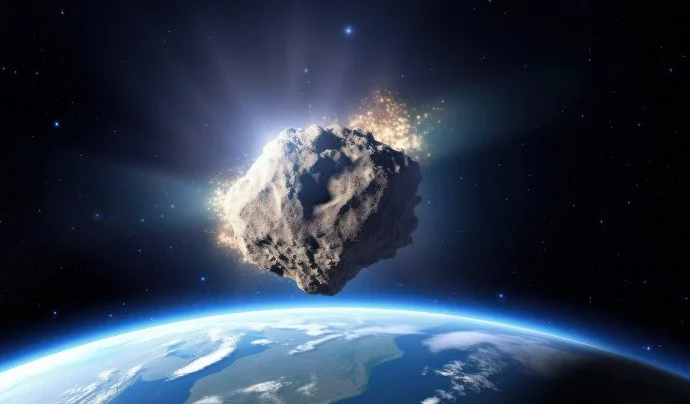
An Airplane-Sized Asteroid to Fly By Earth on Christmas Eve
This Christmas Eve, skywatchers and space enthusiasts are in for a treat as an asteroid roughly the size of a commercial airplane is set to make a close, yet safe, flyby of Earth. Events like these remind us of the dynamic and ever-changing nature of our solar system, while also emphasizing the importance of monitoring near-Earth objects.
Christmas Eve Flyby

Christmas Eve Flyby : Understanding the Asteroid
The asteroid in question, while small in astronomical terms, is significant due to its proximity to Earth. Measuring approximately 25–50 meters in diameter—comparable to the wingspan of a Boeing 737—it is classified as a near-Earth object (NEO). Such objects orbit the Sun and occasionally come close to our planet. Though this asteroid is not a threat, tracking it provides valuable data for planetary defense.
Trajectory and Speed
According to astronomers, the asteroid will pass Earth at a safe distance, far beyond the orbit of the Moon. The exact distance is being closely monitored to ensure accuracy. Traveling at an estimated speed of tens of thousands of kilometers per hour, its journey through space offers scientists a chance to observe and study its behavior, composition, and trajectory.
Why Are Asteroid Flybys Important?
Asteroid flybys, especially those involving objects of this size, serve multiple purposes for researchers:
- Testing Planetary Defense Systems: While this asteroid poses no danger, observing its trajectory allows scientists to test early-warning systems designed to detect potentially hazardous objects.
- Understanding Space Debris: Studying such asteroids sheds light on the composition and origin of space rocks, helping us understand the history of the solar system.
- Raising Public Awareness: Events like these capture public interest, promoting awareness of ongoing efforts to monitor and protect Earth from celestial objects.
How Common Are Asteroid Flybys?
Near-Earth asteroid flybys occur more frequently than most people realize. The majority of these objects are small and burn up in Earth’s atmosphere before reaching the surface. However, larger asteroids, like the one on Christmas Eve, garner attention because of their potential to cause significant damage if their trajectories ever intersected with Earth.
Fortunately, astronomers and space agencies worldwide, including NASA and ESA, are continuously monitoring the skies for such objects. These efforts are part of an international initiative to identify and mitigate asteroid impact threats.
What Can You Expect on Christmas Eve?
For those hoping to catch a glimpse of the asteroid, a telescope will likely be necessary, as its small size and distance will make it difficult to spot with the naked eye. Amateur astronomers can follow updates from space observatories to determine the best viewing times and locations.
Even if it’s not visible to the casual observer, the asteroid’s flyby serves as a fascinating reminder of the vastness of space and the intricate motions of celestial bodies within our solar system.
The Bigger Picture: Asteroid Detection and Prevention
The Christmas Eve asteroid flyby also highlights the growing focus on planetary defense. In recent years, missions like NASA’s DART (Double Asteroid Redirection Test) have showcased humanity’s ability to potentially deflect asteroids. The DART mission, for example, demonstrated the capability to alter an asteroid’s path by impacting it with a spacecraft, paving the way for future planetary defense technologies.
Such advancements underline the importance of international cooperation in space exploration and asteroid detection. While the probability of a catastrophic asteroid impact is low, the consequences of such an event would be severe, making proactive measures essential.
Christmas Eve Flyby : Conclusion
As the asteroid makes its journey past Earth on Christmas Eve, it will do so as a harmless celestial visitor. For scientists, it’s an opportunity to refine tracking techniques and deepen our understanding of near-Earth objects. For the rest of us, it’s a reminder of the vast, interconnected systems that govern our universe.
So, whether you’re stargazing on Christmas Eve or simply marveling at the wonders of space from afar, this event is yet another example of the beauty and complexity of the cosmos.
For More Updates : https://www.trpnewstv.com
WhatsApp channel link :
| More news available on our new website: n7tv – Stay Informed, Stay Ahead |
About the Author