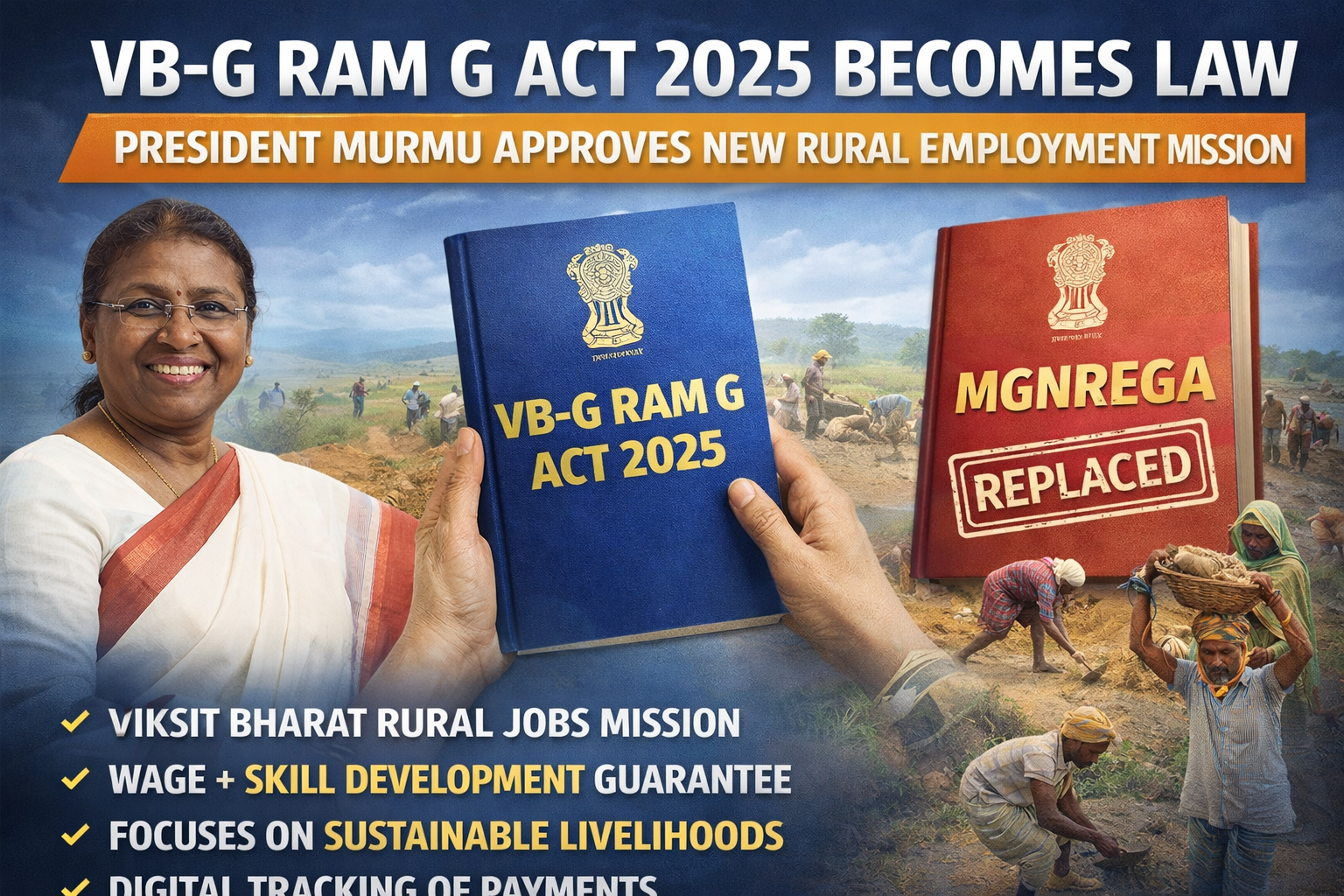
VB-G Ram G 2025 Bill Becomes Law: President Droupadi Murmu Grants Approval — Key Highlights Explained
India has entered a transformative new phase in rural employment and livelihood development after President Droupadi Murmu officially granted approval to the VB-G RAM G 2025 Bill. With this landmark step, the government has replaced the long-existing Mahatma Gandhi National Rural Employment Guarantee Act (MGNREGA) with a newly structured scheme titled “Viksit Bharat – Rojgar Aur Aajeevika Mission (Grameen)”, popularly known as the VB-G Ram G Act 2025.
The bill’s implementation marks one of the most significant rural policy shifts in nearly two decades. The government states that the new act is designed to enhance employment opportunities, improve rural infrastructure, and empower households through sustainable livelihood options.
According to official sources, the mission aims to connect rural labour with innovation-driven development models rather than limiting them to wage-based labour.
The bill had been debated in both houses of Parliament before receiving final approval. After the legislative process was completed, it awaited the signature of the President — the final step in turning the bill into a law. With President Murmu’s assent, the act will now be operational nationwide.
Why VB-G Ram G Replaces MGNREGA
MGNREGA was launched in 2005 and guaranteed 100 days of wage-based work to every rural household. For almost 20 years, it remained one of the largest employment schemes in the world.
However, the government argued that MGNREGA faced limitations, including:
- low productivity outcomes
- infrastructure quality issues
- wage delays
- shortage of skilled jobs
- lack of digital efficiency
The VB-G Ram G Act aims to redesign how rural India works, earns, and participates in development.
Key Objectives of VB-G Ram G Act
The mission focuses on delivering:
- long-term livelihoods
- skill development
- digital access
- rural industrial growth
- entrepreneurial support
- transparent fund tracking
Officials believe the new law will shift rural labour from manual labour dependency to income-based empowerment.
Funding & Structure
The government has assured that funding levels under VB-G Ram G will be equally — if not more — robust than MGNREGA. A digital monitoring system will oversee wage payments, attendance, and work quality. The skill and livelihood component will also bring private-sector participation into rural development.
10 Major Highlights of VB-G Ram G Act, 2025
- MGNREGA officially replaced by a new rural employment and livelihood law.
- Scheme renamed as Viksit Bharat – Rojgar Aur Aajeevika Mission (Grameen).
- Aims at sustainable livelihood, not just wage employment.
- Skill-based opportunities will be created across districts.
- Strong focus on digital transparency and online data tracking.
- Encourages rural entrepreneurship and micro-business support.
- Wage guarantee to continue but with added livelihood components.
- Special support for women and youth employment initiatives.
- Improved infrastructure and productivity outcomes in villages.
- Mission to align with India’s Viksit Bharat 2047 vision.
Political & Public Reaction
The decision has sparked mixed reactions across the country. Supporters believe the move will modernise rural livelihoods and reduce dependency on manual labour. Critics, however, argue that MGNREGA offered guaranteed income security that should not be diluted.
Policy analysts say the success of VB-G Ram G will depend heavily on its execution, wage systems, and inclusion of vulnerable communities.
What Happens Next
The government will soon release detailed programme guidelines outlining job categories, wage structures, digital systems, and implementation phases. District-level infrastructure and training centres are expected to be strengthened to support employment transition.
Rural households currently registered under MGNREGA will be moved to the new mission without losing eligibility.
Conclusion
The VB-G Ram G Act 2025 represents a major structural shift in India’s rural development framework. By integrating employment, livelihood creation, and skill-based opportunities, the mission aims to build a self-reliant rural economy aligned with the nation’s long-term growth plan.
With presidential approval now complete, the new law moves from policy to action — shaping the future of millions of rural workers and marking a new chapter in India’s employment history.
About the Author