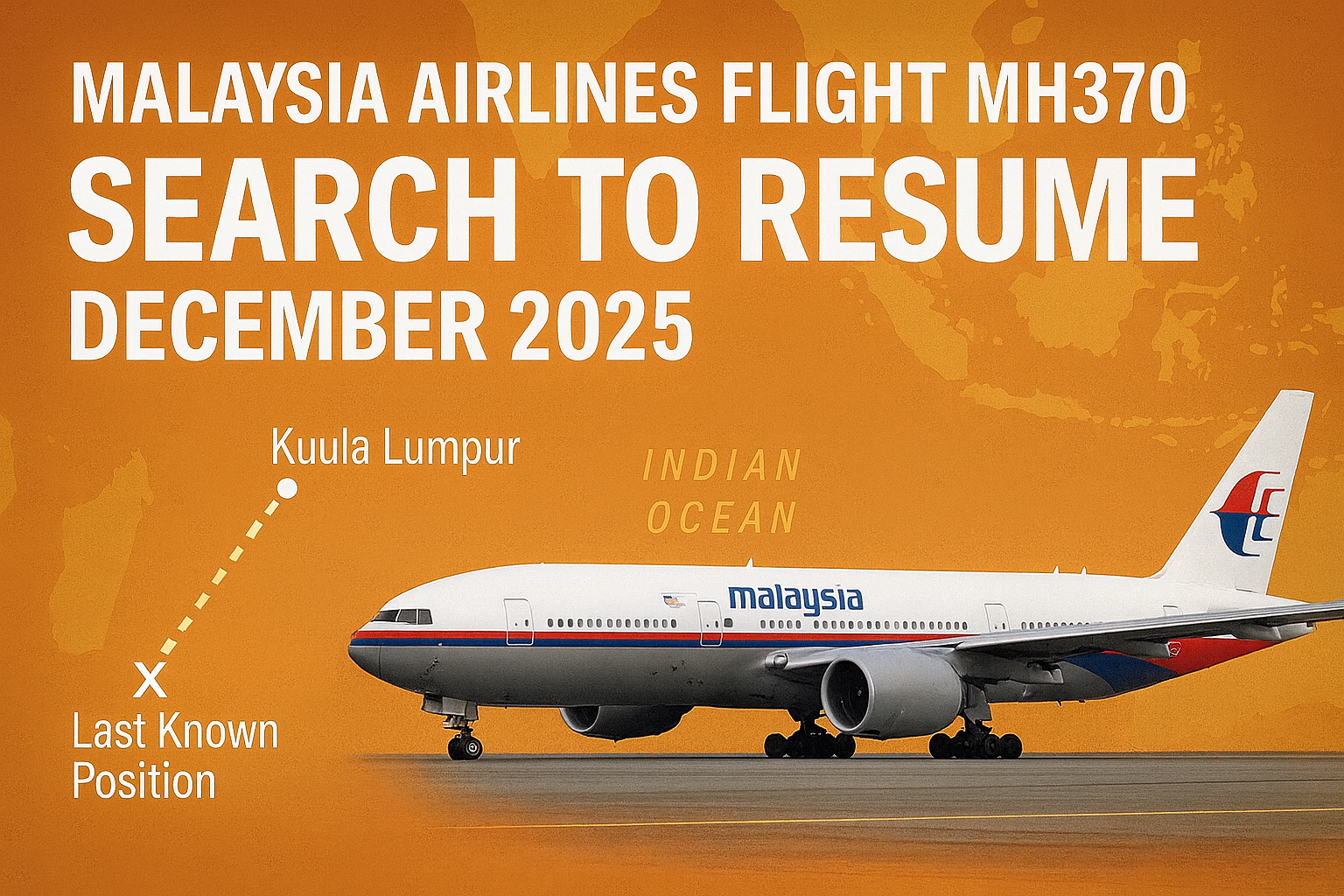
A digital news graphic showing the renewed 2025 search effort for Malaysia Airlines Flight MH370, presented with an orange map background and a Malaysia Airlines Boeing 777.
More than a decade after Malaysia Airlines Flight MH370 vanished without a trace, the case that has haunted aviation is once again moving toward a renewed search effort. The Malaysian government announced that deep-sea recovery operations will officially resume at the end of December 2025, reigniting global attention on a mystery that has left 239 families without answers since March 8, 2014.
MH370 departed Kuala Lumpur bound for Beijing on what was expected to be a routine overnight flight. Within less than an hour, the aircraft’s transponder stopped transmitting, radio contact was lost, and civilian radar signatures disappeared. Military tracking later suggested that the Boeing 777 made a drastic turn westward, crossed over the Malay Peninsula, and flew for several hours across the Indian Ocean before vanishing in one of the most remote stretches of water on Earth. Despite extensive multinational search operations, which at one point became the largest and most expensive in aviation history, investigators have never recovered the plane’s main wreckage or its data recorders.
Over the years, a handful of aircraft fragments believed to be from MH370 washed ashore on islands in the western Indian Ocean, but none have been able to conclusively explain what caused the jet to divert, lose communication, or ultimately crash. Families of the victims have campaigned relentlessly for answers, arguing that the search should continue as long as credible evidence remains.
In December 2025, Malaysian authorities confirmed that the deep-sea search will restart under a new mission led by the U.S. marine robotics company Ocean Infinity. Their exploratory effort — suspended earlier in April due to severe weather — will now resume with updated technology, expanded mapping data, and refined predictions of where the aircraft may have ended its final descent. The new operation is expected to span up to 55 days and will focus on a specific area of the southern Indian Ocean identified by analysts as having the highest probability of containing the wreckage. Under a “no-find, no-fee” agreement, Ocean Infinity will be compensated only if significant evidence or wreckage of MH370 is located.
The announcement has brought a mixture of cautious optimism and emotional tension among families who have spent nearly 12 years seeking closure. For many, the renewed effort feels like a final, necessary step before the search for MH370 could potentially wind down for good. Aviation experts say that a successful discovery would not only answer one of the greatest mysteries in modern flight but could also reshape global aviation safety, satellite tracking standards, and long-haul communication protocols.
As preparations intensify for the late-December launch, the world turns its attention once again to the Indian Ocean, where the hope of finally finding MH370 remains alive. Whether this latest mission brings long-awaited clarity or extends the silence surrounding the tragedy, the coming weeks will be pivotal in determining how — and if — one of aviation’s most painful chapters can finally be closed.
About the Author