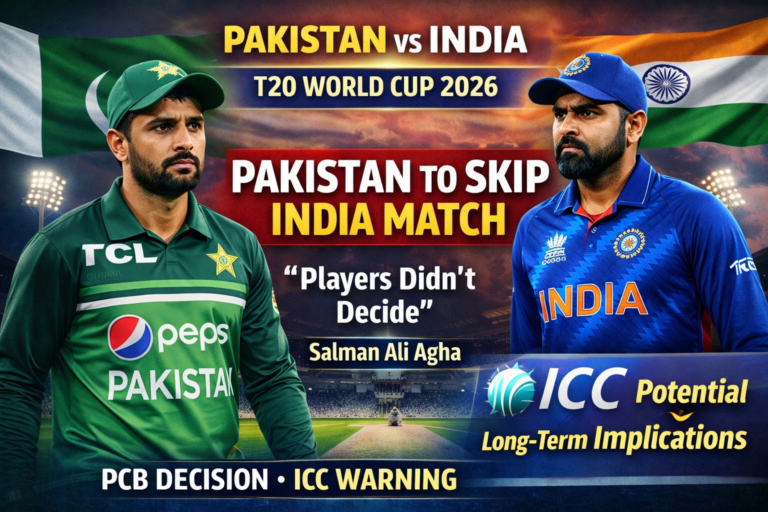
Pakistan Reaffirms Boycott of T20 World Cup Match Against India
Pakistan has once again reaffirmed its decision to boycott the highly anticipated T20 World Cup match against India, intensifying uncertainty around one of cricket’s biggest rivalries. Pakistan Prime Minister Shehbaz Sharif on Wednesday reiterated that the national team will not play the scheduled group-stage match against India during the ICC Men’s T20 World Cup.
The much-awaited encounter is scheduled to take place on February 15 in Colombo, Sri Lanka, but Sharif made it clear that Pakistan has already taken a “firm and considered stand” on the matter and will not reverse its decision.
“Pakistan Has Taken a Clear Stand,” Says PM Shehbaz Sharif
While addressing a cabinet meeting in Islamabad, Prime Minister Sharif stated that Pakistan’s position on the India match is final.
“We have taken a very clear stand that Pakistan will not play against India in the T20 World Cup,” Sharif said. He added that the decision was made after careful deliberation and reflects Pakistan’s broader stance on fairness and principle in international sporting events.
Sharif emphasized that sports should ideally remain separate from politics, but noted that the current situation compelled Pakistan to take a strong position. He further mentioned that Pakistan’s decision was also influenced by solidarity with other cricketing nations that have raised concerns over tournament arrangements.
Background of the Boycott Decision
The boycott comes amid growing tensions surrounding venue allocations and participation issues ahead of the ICC Men’s T20 World Cup. Earlier, Bangladesh had reportedly raised objections regarding playing matches in certain locations, which led to controversy within the international cricketing community.
Pakistan’s leadership views the handling of these concerns as unfair, prompting the government to step in and support a boycott stance. Though the Pakistan Cricket Board has not officially released a detailed statement, it is widely believed that the board is aligned with the government’s position.
ICC and Global Cricket Reaction
The decision has drawn attention from the International Cricket Council, which has expressed concern over selective participation in global tournaments. The ICC maintains that all participating teams are expected to honor their fixtures to ensure sporting integrity and competitive balance.
Cricket boards from other nations are closely monitoring the situation, as an India–Pakistan clash is considered one of the most commercially valuable matches in world cricket. Broadcasters and sponsors have historically relied on this rivalry for massive global viewership.
The Board of Control for Cricket in India has backed the ICC’s position, stating that international tournaments must remain free from political interference and that all teams should abide by tournament rules.
Possible Consequences for Pakistan
If Pakistan officially refuses to play the match, the game could be awarded to India by default, resulting in Pakistan losing valuable points in the group stage. Such a scenario could significantly impact Pakistan’s chances of qualifying for the knockout rounds.
Experts have also warned that Pakistan could face disciplinary action or financial penalties from the ICC if the boycott proceeds. Additionally, fans worldwide may miss out on one of cricket’s most emotionally charged encounters.
Fans React as Uncertainty Continues
Cricket fans across South Asia and beyond have expressed disappointment over the ongoing uncertainty. The India–Pakistan rivalry is often described as the “crown jewel” of international cricket, drawing hundreds of millions of viewers globally.
Despite mounting pressure, Prime Minister Sharif gave no indication that Pakistan would reconsider its stance, leaving the future of the February 15 match hanging in the balance.
As the T20 World Cup approaches, the cricketing world now waits to see whether diplomacy or dialogue can resolve the impasse—or whether the tournament will proceed without its most iconic fixture.
About the Author